Cardrona and Treble Cone: A Town Ski Bus Is Not the Mountain-Road Shuttle
The official Cardrona and Treble Cone transport page describes both buses from town and shuttles covering the mountain access road. Those services begin in different places and solve different parts of the journey. Decide which leg you need before assuming that a free shuttle collects you from accommodation in Queenstown or Wānaka.
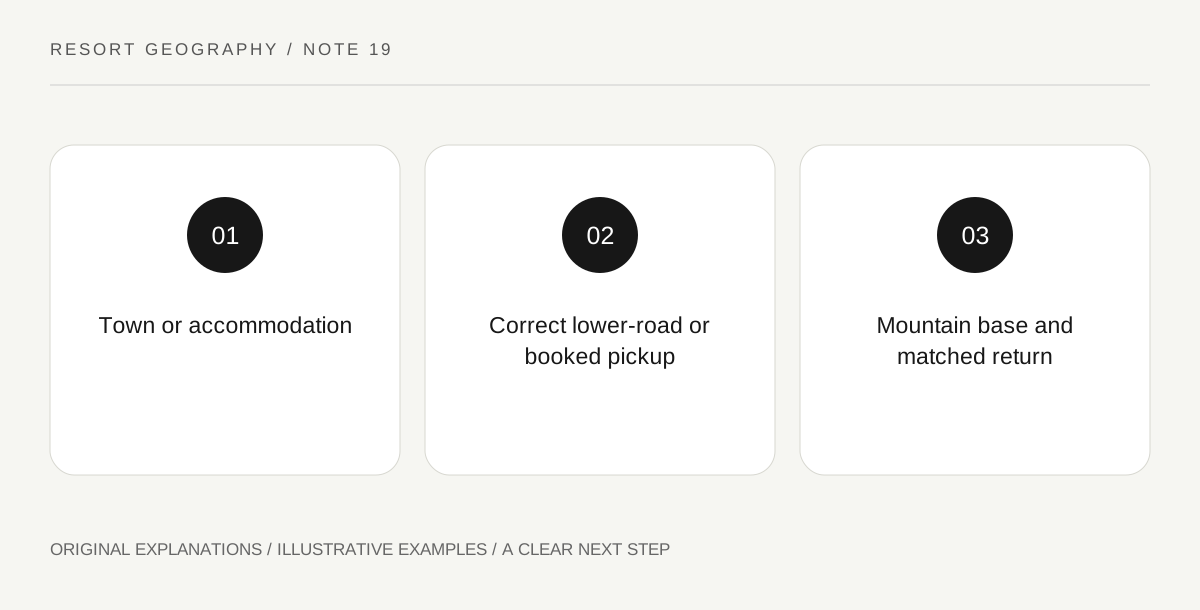
Original explanatory diagram. Read the full method and limitations below.
Draw the town and road-bottom points separately
The operator’s transport information distinguishes town bus services from mountain-road shuttles. Mark accommodation, the relevant town pickup, the lower road shuttle point and the mountain base as separate nodes. A traveler who needs the whole town-to-mountain journey should not arrive at the wrong node expecting an included pickup. The page identifies different lower-road locations for Cardrona and Treble Cone, which reinforces the need to name the actual mountain. The two resorts can appear on one operator website while still requiring different destinations. Use the chosen service’s instructions rather than combining the most convenient phrases from both descriptions.
Choose a booked town journey or a partial-road service
Read what the town bus product includes, its pickup options and return arrangement. Then compare that with the separate road-shuttle description. A free partial connection can be useful for someone already able to reach its starting point, but it is not the same product as return transport from town. Include any journey to that starting point in the comparison. If using a rental vehicle for part of the day, retain responsibility for its conditions and authorized parking rather than treating the shuttle as a general solution to every driving question. Follow current road and operator instructions without improvising winter-driving techniques from this article.
Read capacity and conditions as part of the offer
The road-shuttle information describes first-come service and warns that uphill service can be suspended when capacity is reached. It also states that times can change with weather or road conditions. Those details mean an advertised departure should not be treated as a reserved seat unless the selected product actually provides one. Give a time-sensitive activity provider the actual transport arrangement and ask how to align it with the booking. Do not assume a shuttle will wait because an earlier connection is delayed. The useful decision concerns the whole commitment: the service, its capacity conditions and the activity that depends on reaching the mountain.
Keep the return attached to the same mountain
Before setting out, identify the relevant downward or town-return service, its pickup point and how the group reaches it after the activity. A pass shared across an operator’s resorts does not move a parked car or reserved bus seat from one mountain to another. If changing the intended resort, review the transport booking and collection location rather than updating only the ski plan. Keep equipment handling and bags within the actual provider’s instructions. A clear return closes the diagram you started with: mountain base to lower point or town, then accommodation. That complete chain is the right unit for comparing convenience and cost.
Illustrative shuttle mismatch
A traveler staying in Wānaka initially reads free mountain-road shuttle and assumes hotel pickup is included. A four-node diagram reveals the missing town-to-lower-road leg. The traveler chooses an appropriate confirmed service and records the correct return point for the selected mountain. No departure, seat or road condition is assumed from the example.
Practical checks
Optional checkboxes save only in this browser.
Questions that come up
Does the free mountain-road shuttle collect me from town?
The operator describes the mountain-road shuttle separately from town bus products. Read its actual starting point and arrange any missing leg rather than assuming accommodation pickup.
Does a published shuttle time guarantee a reserved place?
Not when the relevant service is explicitly first-come and capacity-dependent. Read the exact product and coordinate any time-sensitive activity with its actual conditions.
References and scope
These sources support the factual background. Examples and exercises are original illustrative teaching material. References do not imply endorsement.
- Cardrona and Treble Cone: transport — Town buses versus mountain-road shuttles, capacity and condition dependence.